All content on this site is intended for healthcare professionals only. By acknowledging this message and accessing the information on this website you are confirming that you are a healthcare professional. If you are a patient or carer, please visit the International Myeloma Foundation or HealthTree for Multiple Myeloma.
The Multiple Myeloma Hub website uses a third-party service provided by Google that dynamically translates web content. Translations are machine generated, so may not be an exact or complete translation, and the Multiple Myeloma Hub cannot guarantee the accuracy of translated content. The Multiple Myeloma Hub and its employees will not be liable for any direct, indirect, or consequential damages (even if foreseeable) resulting from use of the Google Translate feature. For further support with Google Translate, visit Google Translate Help.


The Multiple Myeloma Hub is an independent medical education platform, sponsored by AbbVie, Roche, Bristol Myers Squibb, Pfizer, GSK, Johnson & Johnson, Legend Biotech and Caribou Biosciences. Funders are allowed no direct influence on our content. The levels of sponsorship listed are reflective of the amount of funding given. View funders.
Now you can support HCPs in making informed decisions for their patients
Your contribution helps us continuously deliver expertly curated content to HCPs worldwide. You will also have the opportunity to make a content suggestion for consideration and receive updates on the impact contributions are making to our content.
Find out more
Create an account to access:
Bookmark & personalize site content
Receive alerts for new content in your areas of interest
View multiple myeloma content recommended for you
Targeting cereblon for the treatment of MM: Rationale and latest data
Do you know... Which mechanism best explains how next-generation CELMoDs overcome resistance to traditional IMiDs in patients with multiple myeloma?
Cereblon is a central therapeutic target in multiple myeloma (MM), as its modulation induces ubiquitination and proteasomal degradation of key transcription factors such as Ikaros (IKZF1) and Aiolos (IKZF3), leading to antimyeloma and immunostimulatory effects.1Immunomodulatory drugs (IMiDs) exert their activity through cereblon binding, providing the mechanistic rationale for targeting this pathway. IMiDs such as lenalidomide, thalidomide, and pomalidomide are key oral agents for the treatment of patients with MM, forming the backbone of frontline induction, consolidation, maintenance, and many regimens for relapsed MM.1 However, acquired resistance – often associated with alterations in cereblon expression or downstream signaling – has driven the development of next-generation cereblon-targeting approaches.1 Prolonged lenalidomide-based maintenance has improved the depth and durability of response in patients with MM but has also reshaped the biology of relapse. An increasing proportion of patients now experiences disease progression during or shortly after lenalidomide treatment, becoming IMiD-refractory upon entering the relapsed setting.1 Lenalidomide-refractory disease at first relapse is associated with inferior outcomes and limited evidence-based follow-up treatment options, particularly in patients also exposed or refractory to proteasome inhibitors (PIs) and anti-CD38 antibodies (triple-class exposed or refractory disease).1 Early relapse after frontline therapy, and the growing population of heavily pretreated, immunotherapy-exposed patients, further highlights the need for agents that retain activity despite prior IMiD exposure and that can be rationally sequenced with monoclonal antibodies, bispecific T-cell engagers (BiTEs), and cellular therapies.1
Proteolysis-targeting chimeras (PROTACs) represent an emerging strategy for targeted protein degradation, further broadening the therapeutic potential of E3 ligase-directed approaches. PROTACs are heterobifunctional molecules that recruit E3 ubiquitin ligases – most commonly cereblon or von Hippel–Lindau (VHL) – to disease-driving proteins, promoting their ubiquitination and proteasomal degradation, enabling the selective elimination of oncogenic targets in MM.2 Preclinical studies demonstrate promising antimyeloma activity and the ability to degrade proteins implicated in drug resistance, although these approaches remain largely at the early preclinical and translational stages of development.2 Next-generation cereblon E3 ligase modulators (CELMoDs) provide additional oral therapeutic options for patients with lenalidomide-refractory, triple-class exposed or refractory, and early-relapsed MM.1 Among these agents, iberdomide and mezigdomide represent the most clinically advanced CELMoDs currently under investigation in MM.1
CELMoDs: Mechanism of action
Cereblon is the substrate receptor within the CUL4–RBX1–DDB1 E3 ubiquitin ligase complex and the central molecular target of both IMiDs and CELMoDs in MM (Figure 1).1 IKZF1 and IKZF3 are highly expressed and functionally required in MM cells, and next-generation CELMoDs, including iberdomide and mezigdomide, are structurally optimized cereblon-binding agents that induce deeper and more sustained degradation of IKZF1 and IKZF3 than traditional IMiDs.1 While IMiDs bind cereblon and induce degradation of IKZF1 and IKZF3, next-generation CELMoDs are designed to enhance cereblon engagement and stabilize interactions between cereblon and its substrates, thereby increasing the efficiency of the CUL4–RBX1–DDB1 E3 ubiquitin ligase complex and enabling deeper, more sustained target protein degradation. Enhanced degradation of IKZF proteins leads to downstream reductions in IRF4 and MYC expression, transcriptional drivers of myeloma cell survival and proliferation.1 Enhanced IKZF degradation also augments immune effector function, promoting T-cell activation, cytokine production, and natural killer cell-mediated cytotoxicity.1
Figure 1. Mechanism of action of next-generation CELMoDs in MM*
.png)
CELMoDs: Key trials and latest data
Iberdomide
Iberdomide first entered clinical development in heavily pretreated relapsed/refractory MM (RRMM) in the phase I/II CC-220-MM-001 trial (NCT02773030). Data from the phase I dose-escalation and phase II expansion cohorts established proof-of-concept for iberdomide in IMiD-exposed and refractory disease.1,3 The trial also investigated iberdomide for the treatment of patients with newly diagnosed MM (NDMM), as monotherapy, and in various combinations including iberdomide + dexamethasone, iberdomide + dexamethasone + daratumumab (IberDd), iberdomide + dexamethasone + bortezomib (IberVd), and iberdomide + dexamethasone + carfilzomib (IberKd). Across these studies, iberdomide demonstrated promising antimyeloma activity, including in heavily pretreated and IMiD-refractory populations, with high overall response rates (ORRs) and deepening responses over time. However, consistent with the CELMoD class, hematologic adverse events (AEs) – particularly neutropenia – were common, highlighting the importance of monitoring and supportive care in these patients.1,3 Key data for clinical trials of iberdomide in MM are summarized in Table 1. Key updates from recent congresses and peer reviewed publications are summarized below.
IberDd
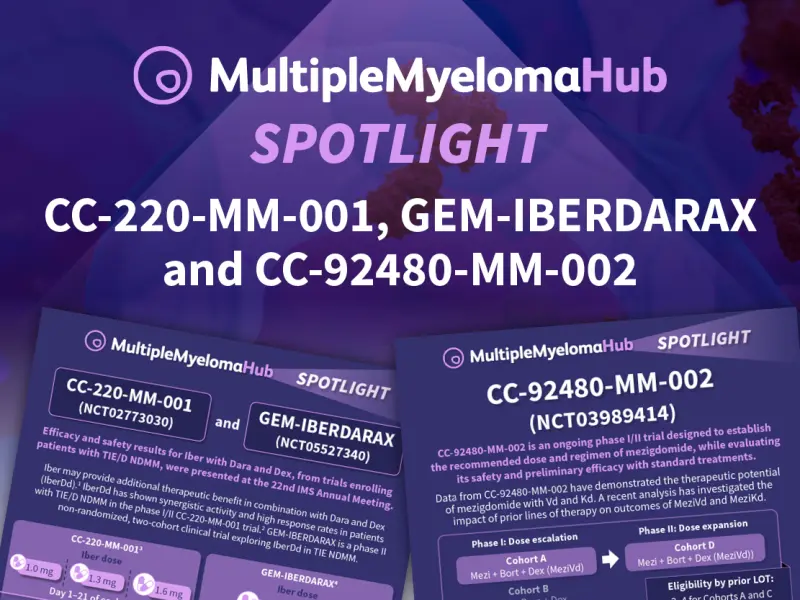
An update from the CC-220-MM-001 trial, presented at the 22nd International Myeloma Society Annual Meeting (IMS 2025), September 17–20, 2025, Toronto, CA, reported an overall response rate (ORR) of 94.7% with a median follow-up of 22.3 months for IberDd in patients with transplant-ineligible or deferred newly diagnosed multiple myeloma (TI NDMM) (N = 75).4 Grade 3/4 neutropenia and infections were observed in 78.7% and 52.0% of patients, respectively.4 A subgroup analysis from the trial, presented at the 67th American Society of Hematology Annual Meeting and Exposition (ASH 2025), Dec 6–9, 2025, Orlando, US, demonstrated that renal impairment (RI) does not affect the efficacy or safety of IberDd in this population (N = 74).5 ORRs for patients with no RI, mild RI, and moderate RI were 90.0%, 93.1%, and 97.1%, respectively. Neutropenia and infections were observed in 78.4% and 52.7% of patients, respectively.5 These findings are consistent with previous findings for iberdomide + dexamethasone in patients with RRMM.5 A longitudinal analysis of measurable residual disease (MRD) negativity and immune dynamics in patients with TI NDMM treated with IberDd from the CC-220-MM-001 trial, presented at ASH 2025, demonstrated robust activity that deepened over time, with high rates of MRD-negativity that correlated with progression-free survival (PFS).6 The rate of patients achieving MRD negativity with complete response (CR) or better (MRD-negative CR) at any time was 53.3%.6 IberDd also demonstrated high response rates in patients with TI NDMM in the phase II GEM-IBERDARAX (NCT05527340) trial.7 An update from IMS 2025 reported an ORR of 93.1%, with Grade 3 neutropenia and infections observed in 67.5% and 16.9% of patients, respectively.7 Overall, IberDd demonstrates high response rates in patients with TI NDMM, although neutropenia and infections remain common AEs.4–7
EXCALIBER RRMM (NCT04975997) is an ongoing phase III trial designed to address IberDd dose optimization and to compare the efficacy and safety of the selected IberDd dose with daratumumab + bortezomib + dexamethasone (DVd) in patients with early-line RRMM (1 or 2 prior lines of therapy [LoT]).8 On February 17, 2026, the U.S. Food and Drug Administration (FDA) accepted a new drug application for IberDd for the treatment of patients with RRMM.9 The application is supported by an interim MRD analysis from the EXCALIBER-RRMM study, which evaluated IberDd vs DVd in patients with RRMM. Co-primary endpoints included MRD and PFS. Secondary endpoints included overall survival (OS), duration of response (DoR), ORR, time to next treatment, time to progression, and health-related quality of life.9 The FDA also granted breakthrough therapy designation for iberdomide based on these data, and a Prescription Drug User Fee Act (PDUFA) date of August 17, 2026.9
IberVd
In the CC-220-MM-001 IberVd cohort (RRMM; N = 25), the ORR was 56%, with a median follow up of 4.86 months.3 Results from the trial, presented at the European Hematology Association (EHA) 2025 Congress, June 12–15, 2025, Milan, IT (N = 18), showed that with a median follow up of 25.0 months IberVd demonstrated deep and durable responses in patients with TI NDMM over 2 years of treatment, with an ORR of 88.9% and a ≥CR rate of 66.6%.10 Neutropenia was observed in 41.2% of patients (Grade 3/4 29.4%), with infections in 82.4% of patients (Grade 3/4, 47.1%).10 These data support further evaluation of iberdomide combinations, including IberVd, in the frontline setting.10
Iberdomide + elranatamab
Data presented at ASH 2025 provide further support for the evaluation of iberdomide in combination therapy settings. In Part 1 of the phase Ib MagnetisMM-30 trial (NCT06215118) in patients with RRMM (N = 22), iberdomide + elranatamab achieved an ORR of 95.5%, with a safety profile consistent with the individual AE profiles of each agent.11 Grade 3/4 neutropenia was observed in 72.7% of patients, with no Grade 3/4 cytokine release syndrome (CRS) events.11 These early data suggest encouraging efficacy for the combination, with a manageable safety profile. The study is ongoing and recruiting patients for Part 2, which will randomize a larger group of patients with RRMM to two dosing schedules of elranatamab + iberdomide.11
Iberdomide + low-dose cyclophosphamide + dexamethasone (IberCd)
The phase II ICON study (NCT04392037) of iberdomide + low-dose cyclophosphamide + dexamethasone (IberCd) in patients with RRMM (N = 61) demonstrated an ORR of 82%, with a median PFS of 17.6 months at a median follow-up of 25.4 months.12 Neutropenia was observed in 61% of patients (Grade 3/4, 56%).12 These findings suggest that IberCd may represent an active, all-oral combination for patients with RRMM, with clinically meaningful activity. This regimen may offer a valuable treatment option for patients who have received two to four previous lines of therapy.12
Iberdomide + ixazomib + dexamethasone (I2D)
The phase II I2D IFM2021_03 study (NCT04998786) investigated the oral triplet iberdomide + ixazomib + dexamethasone (I2D) in patients with MM aged ≥70 years at first relapse (N = 70).13 With a median follow-up of 14 months, the ORR was 64%, with a very good partial response or better (≥VGPR) rate of 36%.13 The 12-month PFS, DoR, and OS rates were 52%, 76%, and 86%, respectively. The most common Grade 3–4 toxicity was neutropenia, observed in 46% of patients. Overall, I2D showed a manageable safety profile and clinical activity in elderly patients with MM at first relapse, including in patients with lenalidomide- and daratumumab-refractory disease.13
Iberdomide maintenance post‑transplant
In the post-transplant maintenance setting, the phase II EMN26 trial (NCT04564703) is evaluating iberdomide following autologous hematopoietic stem cell transplantation (auto-HSCT) in patients with NDMM. Data from the trial, presented at ASH 2025, reported improved response rates over 24 cycles. Iberdomide resulted in response improvement in 57–72% of patients by Cycle 24, defined as a deepening of response category (e.g. partial response [PR] to ≥VGPR, VGPR to ≥CR, or CR to stringent CR [sCR]), with 2-year PFS rates of 82–92% and 1-year sustained measurable residual disease (MRD) negativity (10-5) rates of 57–70%.14 This deepening of responses over successive cycles supports the potential role of iberdomide as an alternative post-transplant maintenance strategy.14 The most common Grade 3/4 hematologic AE was neutropenia, observed in 48–60% of patients across the 0.75–1.3 mg dose cohorts.14 Few Grade ≥3 nonhematologic AEs occurred, other than Grade ≥3 infections in 8–18% of patients.14 A 0.75 mg dose of iberdomide was determined as the recommended maintenance dose for further evaluation, based on comparable efficacy with superior tolerability, compared with higher doses.14 The findings showed that iberdomide maintenance resulted in an improvement in response over time in patients who received IMiD- or PI-based induction ± anti-CD38 antibody and auto-HSCT, which appears encouraging relative to historical lenalidomide maintenance experience. The ongoing phase III EXCALIBER Maintenance (NCT05827016) trial will compare iberdomide maintenance vs lenalidomide maintenance therapy following auto-HSCT in patients with NDMM.14 Findings from these trials will further inform the potential positioning of iberdomide across the MM treatment continuum.
Table 1. Key data for clinical trials of iberdomide in MM
| Trial | Phase | Population | Regimen | Key efficacy data | Grade ≥3 AEs |
|---|---|---|---|---|---|
| CC-220-MM-0013 (NCT02773030) | Phase I/II | N = 197 (dose-escalation, n = 90; dose-expansion, n = 107); heavily pretreated RRMM | Iberdomide + dexamethasone | ORR, 32%; median FU, 5.8 months (dose-escalation cohort) and 7.7 months (dose-expansion cohort) | Neutropenia, 45%; anemia, 28%; infections, 27%; thrombocytopenia, 22% |
| CC-220-MM-001 IberDd cohort4 (NCT02773030) | Phase I/II | N = 75; TI NDMM | Iberdomide + daratumumab + dexamethasone | ORR, 94.7%; median FU, 22.3 months | Neutropenia, 78.7%; infections, 52.0% |
| CC-220-MM-001 IberVd cohort10 (NCT02773030) | Phase I/II | N = 18; TI NDMM | Iberdomide + bortezomib + dexamethasone | ORR, 88.9%; ≥CR 66.6%; median FU, 25.0 months | Infections, 47.1%; neutropenia, 29.4% |
EMN2614 | Phase II | N = 120; n = 40 (1.3 mg) + n = 40 (1.0 mg); n = 40 (0.75 mg); maintenance post-auto-HSCT NDMM | Iberdomide monotherapy | After 24 cycles: sCR, 57.5% (1.3 mg); 52.5% (1.0 mg); 67.5% (0.75 mg); PFS 24 months, 82–92%; median FU, 37.5 months (1.3 mg); 37.4 months (1.0 mg); 27.8 months (0.75 mg) | Neutropenia, 60% (1.3 mg); 58% (1.0 mg); 48% (0.75 mg); infections, 18% (1.3 mg); 18% (1.0 mg); 8% (0.75 mg) |
| MagnetisMM-3011 (NCT06215118) | Phase Ib | N = 22; RRMM; 2–4 LoT | Iberdomide + elranatamab | ORR, 95.5%; median FU, 7.8 months | Neutropenia, 72.7%; no Grade 3/4 CRS |
| GEM-IBERDARAX IberDd cohort7 (NCT05527340) | Phase II | N = 77 (N = 73 efficacy evaluable); transplant ineligible NDMM | Iberdomide + daratumumab + dexamethasone | ORR, 93.1%; median FU, 11 months | Neutropenia, 67.5%; infections, 16.9% |
| ICON12 (NCT04392037) | Phase II | N = 61; RRMM | Iberdomide + low-dose cyclophosphamide + dexamethasone | ORR, 82%; CR, 15%; VGPR, 34%; PR, 33%; PFS, 17.6 months; median FU, 25.4 months | Neutropenia, 56%; infections, 34% |
| I2D IFM2021_0313 (NCT04998786) | Phase II | N = 70; RRMM aged ≥70 years at first relapse; 1 prior LoT | Iberdomide + ixazomib + dexamethasone | ORR, 64%; ≥VGPR, 36%; 12-month PFS, DoR, and OS, 52%, 76%, and 86% respectively; median FU, 14 months | Neutropenia, 46%; infections, 8% |
| EXCALIBER RRMM (NCT04975997) | Phase III | N = 864 (estimated); RRMM | Iberdomide + daratumumab + dexamethasone vs daratumumab + bortezomib + dexamethasone | Primary completion (estimated), March 2026; study completion (estimated), June 2032 | |
| EXCALIBER Maintenance (NCT05827016) | Phase III | N = 1,216 (estimated); maintenance post-auto-HSCT NDMM | Iberdomide vs lenalidomide | Primary completion (estimated), March 2029; study completion (estimated), June 2032 | |
| AE, adverse event; auto-HSCT, autologous hematopoietic stem cell transplant; CR, complete response; CRS, cytokine release syndrome; DoR, duration of response; FU, follow-up; IberDd, iberdomide + daratumumab + dexamethasone; IberVd, iberdomide + bortezomib + dexamethasone; MM, multiple myeloma; NDMM, newly diagnosed MM; ORR, overall response rate; PFS, progression-free survival; PR, partial response; RRMM, relapsed/refractory multiple myeloma; SAE, serious AE; sCR, stringent complete response; TI, transplant-ineligible or deferred; VGPR, very good partial response. | |||||
Mezigdomide
Several trials are investigating the efficacy and safety of mezigdomide combinations across treatment settings. The pivotal phase I/II CC-92480-MM-001 trial (NCT03374085) evaluated mezigdomide + dexamethasone in patients with RRMM, demonstrating efficacy in a highly refractory cohort.15 Key data for clinical trials of mezigdomide in MM are summarized in Table 2. Key updates from recent congresses and peer reviewed publications are summarized below.
MeziVd and MeziKd
Data from the phase I/II CC-92480-MM-002 trial (NCT03989414), presented at ASH 2024, demonstrated promising efficacy for both mezigdomide + bortezomib + dexamethasone (MeziVd; Cohorts A and D) and mezigdomide + carfilzomib + dexamethasone (MeziKd; Cohort C) in patients with RRMM previously exposed to IMiDs.16 The ORRs were 75.0%, 85.2%, and 85.7%, respectively, with a median PFS ≥1 year in all cohorts.16 In the dose-escalation cohorts, the most common Grade 3/4 TEAEs were neutropenia (35.7%), thrombocytopenia (21.4%), and infections (17.9%) with MeziVd, and neutropenia (44.4%) and infections (33.3%) with MeziKd.16 An updated analysis from the trial, presented at IMS 2025, demonstrated ORRs of 71.4–88.4% across 1–4 prior LoT.17 Fewer LoT were associated with increased PFS, ranging from 19.4 months with 1 prior LoT to 9.2 months with 4 LoT.17 The most common AE was neutropenia (52.9%). These findings suggest the antimyeloma activity of mezigdomide regimens, including in heavily pretreated patients, and support the investigation of mezigdomide-based regimens in phase III trials.16,17
The phase III SUCCESSOR-1 trial (NCT05519085; mezigdomide + bortezomib + dexamethasone [MeziVd] vs pomalidomide + bortezomib + dexamethasone [PVd]) and the phase III SUCCESSOR-2 trial (NCT05552976; mezigdomide + carfilzomib + dexamethasone [MeziKd] vs carfilzomib + dexamethasone [Kd]), in patients with RRMM, are currently recruiting and will provide further insights into the potential utility of mezigdomide in the MM treatment landscape.18
Mezigdomide + dexamethasone + EZH2/BET/MEK inhibitors
The phase Ib/IIa CA057-003 trial (NCT05372354) assessed mezigdomide + dexamethasone combined with an EZH2 inhibitor (tazemetostat), a BET inhibitor (BMS-986158), or a MEK inhibitor (trametinib), in patients with heavily pretreated RRMM.19 Findings from the trial presented at EHA 2025 demonstrated ORRs of 50%, 35%, and 80%, respectively.19 Grade 3/4 neutropenia was observed in 56.3%, 65.0%, and 85.0% of patients, respectively, with Grade 3/4 infections in 25%, 20%, and 40% of patients, respectively. These results provide a rationale for further investigation of mezigdomide in these novel, all-oral, triplet combinations for heavily pretreated RRMM.19
Mezigdomide + elranatamab
Initial results from Part 1 of the phase I/II MELT-MM trial (NCT06645678) of mezigdomide + elranatamab in patients with RRMM (N = 11) demonstrated an ORR of 90%, with ≥CR in 50% of patients.20 For patients treated for three or more cycles (N = 7; median follow-up, 5.6 months), the ORR was 100%, with a ≥CR rate of 71.4%. CRS was observed in 54.5% of patients (all Grade 1), and there were no cases of neurologic AEs. These initial results suggest mezigdomide + elranatamab is clinically feasible with therapeutic potential.20
Mezigdomide + selinexor + dexamethasone (SMd)
Preliminary results from the phase I/II STOMP trial (NCT02343042) of mezigdomide + selinexor + dexamethasone (SMd) demonstrated an ORR of 50%, with a clinical benefit rate of 50% in heavily pretreated patients with RRMM.21 The most common TEAE was neutropenia (85%; 54% Grade 3/4).21 These findings support the continued investigation of SMd in patients with RRMM with selinexor 60 mg once weekly (QW) + mezigdomide 0.6 mg once daily (QD) + dexamethasone 40 mg QW as the recommended phase II dose (RP2D).21
Table 2. Key data for clinical trials of mezigdomide in MM
| Trial | Phase and design | Population | Regimen | Key efficacy data | Grade ≥3 AEs |
|---|---|---|---|---|---|
| CC-92480-MM-00115 (NCT03374085) | Phase I | N = 77; RRMM median 6 prior LoT; 78% prior auto-HSCT | Mezigdomide + dexamethasone | ORR, 25% (CR, 1%; VGPR, 12%; PR, 12%); median FU, 6.3 months | Neutropenia: Grade 3, 23% and Grade 4, 48%; infections: Grade 3, 36% and Grade 4, 4%; anemia: Grade 3, 38% |
| CC-92480-MM-00115 (NCT03374085) | Phase II | N = 101; RRMM; triple-class refractory | Mezigdomide + dexamethasone | ORR, 41% (sCR, 2%; CR, 3%; VGPR, 20%; PR, 16%); PFS, 4.4 months; median FU, 7.5 months | Neutropenia: Grade 3, 22% and Grade 4, 54%; infections: Grade 3, 29% and Grade 4, 6%; anemia: Grade 3, 35% and Grade 4, 1% |
| CC-92480-MM-00216 (NCT03989414) Cohort A (MeziVd) | Phase I/II, dose-escalation | N = 28; RRMM; 2–4 prior LoT | Mezigdomide + bortezomib + dexamethasone | ORR, 75.0%; ≥VGPR, 39.3%; median DoR, 10.9 months; median PFS: 11.8 months; median FU, 13.6 months
| Neutropenia, 35.7%; thrombocytopenia, 21.4%; infections, 17.9% |
| CC-92480-MM-00216 (NCT03989414) Cohort C (MeziKd) | Phase I/II, dose-escalation | N = 27; RRMM; 2–4 prior LoT | Mezigdomide + carfilzomib + dexamethasone | ORR, 85.2%; ≥VGPR 44.4%; median DoR, 11.9 months; median PFS 13.5 months; median FU, 15.2 months
| Neutropenia, 44.4%; infections, 33.3% |
| CC-92480-MM-00216 (NCT03989414) Cohort D (MeziVd) | Phase I/II, dose-expansion | N = 49; RRMM; 1–3 prior LoT | Mezigdomide + bortezomib + dexamethasone | ORR, 85.7%; ≥VGPR, 63.3%; median DoR, 19.4 months; median PFS, 17.5 months; median FU, 18.3 months | Neutropenia, 63.3%; infections, 32.7%; thrombocytopenia, 26.5% |
| CA057-00319 NCT05372354 | Phase Ib/IIa | N = 56; RRMM; heavily pretreated, median 5 prior LoT | Mezigdomide + dexamethasone + tazemetostat (n = 16), BMS-986158 (n = 20), or trametinib (n = 20) | ORRs, 50%, 35%, and 80%; median FU, 7.0, 4.6, and 8.2 months | Neutropenia, 56.3%, 65.0%, and 85.0%; Infections, 25%, 20% and 40% |
| MELT-MM20 NCT06645678 | Phase I/II | N = 11 (n = 10 response evaluable); RRMM | Mezigdomide + elranatamab | Overall (N = 11): ORR, 90%; ≥VGPR, 60%; ≥CR, 50%. For patients treated for ≥3 cycles (N = 7): ORR, 100%; ≥VGPR, 100%, ≥CR, 71.4%; median FU, 5.6 months | Not reported |
| STOMP Arm 1221 (NCT02343042) | Phase I/II | N = 13 (phase I); RRMM | Mezigdomide + selinexor + dexamethasone | ORR, 50% | Neutropenia, 54% |
| SUCCESSOR-118 (NCT05519085) | Phase III | N = 810 (estimated); RRMM | Mezigdomide + bortezomib + dexamethasone vs pomalidomide + bortezomib + dexamethasone | Primary completion (estimated), January 2027; study completion (estimated), November 2033 | |
| SUCCESSOR-218 (NCT05552976) | Phase III | N = 525 (estimated); RRMM | Mezigdomide + carfilzomib + dexamethasone vs carfilzomib + dexamethasone | Primary completion (estimated), February 2026; study completion (estimated), July 2029 | |
| AE, adverse event; ASCT, autologous stem cell transplantation; BCMA, B-cell maturation antigen; CR, complete response; dex, dexamethasone; DoR, duration of response; FU, follow-up; IMiD, immunomodulatory drug; LoT, lines of therapy; MeziEd; mezigdomide + elotuzumab + dexamethasone; MeziDd; mezigdomide + daratumumab + dexamethasone; MeziKd; mezigdomide + carfilzomib + dexamethasone; MeziVd; mezigdomide + bortezomib + dexamethasone; NDMM, newly diagnosed multiple myeloma; ORR, overall response rate; PFS, progression-free survival; PI, proteasome inhibitor; PR, partial response; RRMM, relapsed/refractory multiple myeloma; sCR, stringent complete response; VGPR, very good partial response. | |||||
Future directions
Findings from multiple clinical trials of next-generation CELMoDs support their integration into treatment strategies across the MM treatment continuum.1 However, the optimal sequencing of CELMoDs relative to established immunomodulatory drugs, CD38-directed monoclonal antibodies, bispecific antibodies, and cellular therapies remains to be defined. Synergy with CD38-directed monoclonal antibodies remains a central focus, with combinations such as iberdomide + daratumumab being evaluated in phase III studies, including EXCALIBER-RRMM, to define their role in early relapse settings.1,4-7,12 Similar rationale supports combinations with isatuximab, leveraging enhanced immune effector function and antibody-dependent cellular cytotoxicity.1 Proteasome inhibitor-based regimens also represent a rational basis for combination strategies with CELMoDs, given complementary mechanisms targeting proteostasis and transcriptional survival pathways.1 The SUCCESSOR-1 trial is currently evaluating a proteasome inhibitor-based regimen (mezigdomide + bortezomib + dexamethasone).21 A particularly promising avenue for CELMoD development is integration with T-cell-redirecting therapies.1,9 Bispecific antibodies targeting BCMA or GPRC5D may benefit from CELMoD-mediated enhancement of T-cell activation and function, potentially improving response depth and durability. However, long-term safety considerations remain critical. The impact of treatment-related cytopenias, particularly neutropenia, and associated infection risk during prolonged CELMoD exposure requires continued evaluation in ongoing clinical trials and real-world studies.1 Recent advances in the development of PROTACs may provide another strategy that utilizes cereblon-mediated protein degradation and could lead to clinical trials that may reveal their potential within the therapeutic landscape.2
Conclusions
Next-generation CELMoDs build upon the established immunomodulatory drug platform and were developed to address resistance mechanisms and further explore cereblon-targeted therapy in MM.1 Enhanced cereblon engagement and deeper degradation of key transcriptional regulators provide a biologic basis for activity in lenalidomide-refractory and triple-class exposed disease, addressing a critical area of unmet need; emerging clinical data support this rationale.1,3,9,12,13,15,21 Iberdomide and mezigdomide have demonstrated meaningful activity in RRMM, including heavily pretreated populations, and encouraging efficacy in combination with CD38 monoclonal antibodies, proteasome inhibitors, and T-cell-redirecting therapies.1,3,9,12,13,15,21 Early results in newly diagnosed and post-auto-HSCT maintenance settings suggest a potential role beyond late-line disease, with evidence of response deepening over time.1,12 Ongoing phase III programs, including EXCALIBER and SUCCESSOR, are expected to clarify optimal positioning, sequencing, and long-term safety, and will determine how CELMoDs are integrated into the MM treatment landscape.1,13,21
This educational resource is independently supported by Bristol Myers Squibb. All content was developed by SES in collaboration with an expert steering committee. Funders were allowed no influence on the content of this resource.
References
Please indicate your level of agreement with the following statements:
The content was clear and easy to understand
The content addressed the learning objectives
The content was relevant to my practice
I will change my clinical practice as a result of this content
Your opinion matters
Regarding bispecific antibodies for multiple myeloma, which of the following AE mitigation strategies do you use most routinely in your practice?