All content on this site is intended for healthcare professionals only. By acknowledging this message and accessing the information on this website you are confirming that you are a healthcare professional. If you are a patient or carer, please visit the International Myeloma Foundation or HealthTree for Multiple Myeloma.
The Multiple Myeloma Hub website uses a third-party service provided by Google that dynamically translates web content. Translations are machine generated, so may not be an exact or complete translation, and the Multiple Myeloma Hub cannot guarantee the accuracy of translated content. The Multiple Myeloma Hub and its employees will not be liable for any direct, indirect, or consequential damages (even if foreseeable) resulting from use of the Google Translate feature. For further support with Google Translate, visit Google Translate Help.


The Multiple Myeloma Hub is an independent medical education platform, sponsored by AbbVie, Roche, Bristol Myers Squibb, Pfizer, GSK, Johnson & Johnson, Legend Biotech and Caribou Biosciences. Funders are allowed no direct influence on our content. The levels of sponsorship listed are reflective of the amount of funding given. View funders.
Now you can support HCPs in making informed decisions for their patients
Your contribution helps us continuously deliver expertly curated content to HCPs worldwide. You will also have the opportunity to make a content suggestion for consideration and receive updates on the impact contributions are making to our content.
Find out more
Create an account to access:
Bookmark & personalize site content
Receive alerts for new content in your areas of interest
View multiple myeloma content recommended for you
Symposium | Real-world insights and clinical experience with BCMA‑directed therapies
Featured:
 Gordon Cook
Do you know... In real-world clinical practice, how does prior exposure to a BCMA-directed therapy generally affect outcomes with a subsequent BCMA-directed therapy?
On December 17, 2025, the Multiple Myeloma Hub held a virtual symposium, titled Integrating novel BCMA-directed therapies into clinical practice: Insights from real-world experience. During the symposium, Gordon Cook, University of Leeds, UK, delivered a presentation covering real-world insights and clinical experience with BCMA-directed therapies.
In this presentation, Cook examined how populations enrolled in pivotal trials of B-cell maturation antigen (BCMA)-directed therapies compare with patients treated in routine clinical practice. Key differences were highlighted, including age, performance status, comorbidities, and prior treatment exposure. Cook presented data for bispecific antibodies and CAR T-cell therapies, focusing on efficacy and safety outcomes in real-world populations, as well as the impact of prior BCMA exposure on response and durability of response. Real-world experience with management of adverse events, particularly infections and ocular complications, was also discussed, as were the implications of these findings for treatment sequencing as BCMA-directed therapies move into earlier lines of therapy.
Symposium | Real-world insights and clinical experience with BCMA‑directed therapies
Symposium | Real-world insights and clinical experience with BCMA‑directed therapies
Key points
- Patients enrolled in pivotal trials of BCMA-directed therapies are typically younger, fitter, and have fewer comorbidities than those treated in routine clinical practice, which may limit the applicability of trial outcomes to real-world settings.1–8
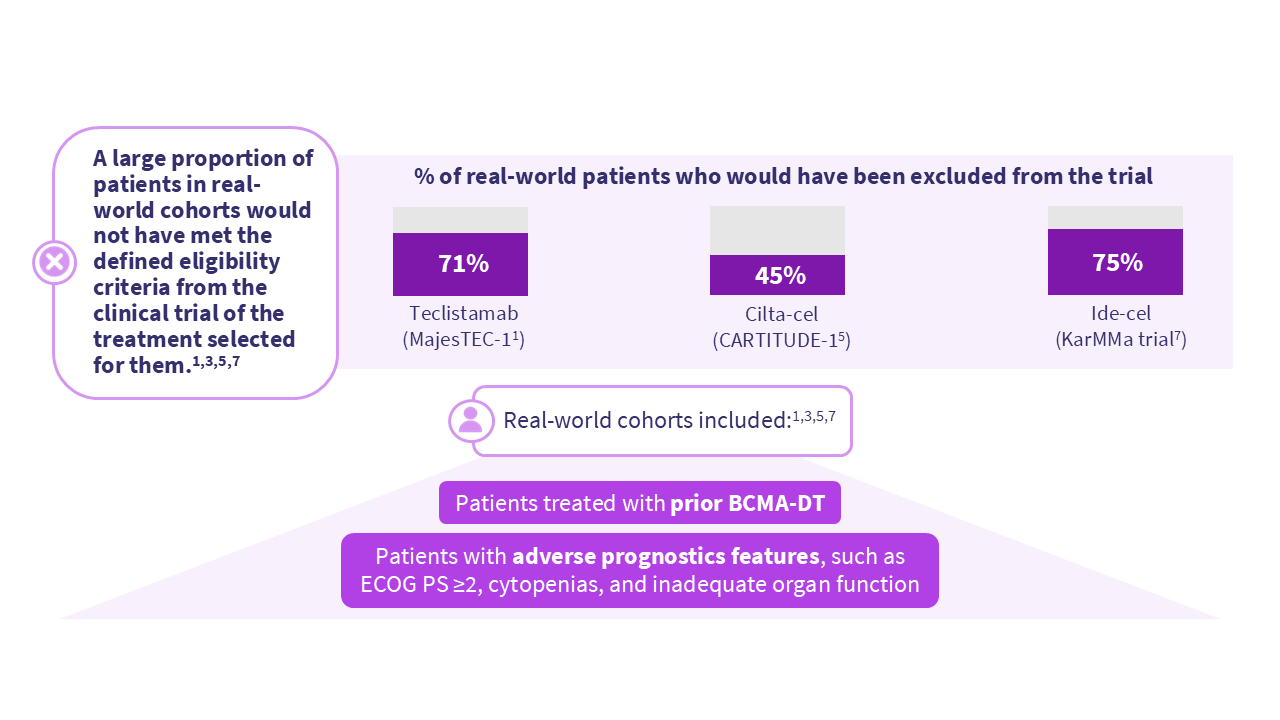
- Real-world analyses suggest that a substantial proportion of patients treated in clinical practice would not have met eligibility criteria for pivotal trials of BCMA-directed therapies, most commonly due to older age, poorer performance status, or impaired organ function (Figure 1).1–8
Figure 1. Characteristics of real-world populations treated with BCMA-directed therapies*
- Real-world efficacy outcomes with BCMA-directed bispecific antibodies and CAR T-cell therapies appear largely comparable with those reported in clinical trials, despite treatment of broader patient populations .1–4,7,8
- Prior exposure to BCMA-directed therapies has been associated with reduced response rates and shorter progression-free survival in real-world datasets, highlighting the potential impact of prior BCMA-exposure on subsequent treatment outcomes.1,3,7
- Real-world safety data suggest that rates of cytokine release syndrome and neurotoxicity are generally similar to, or slightly lower than, those reported in clinical trials, although infections remain a clinically significant complication requiring close monitoring and supportive care.1–4,7,8
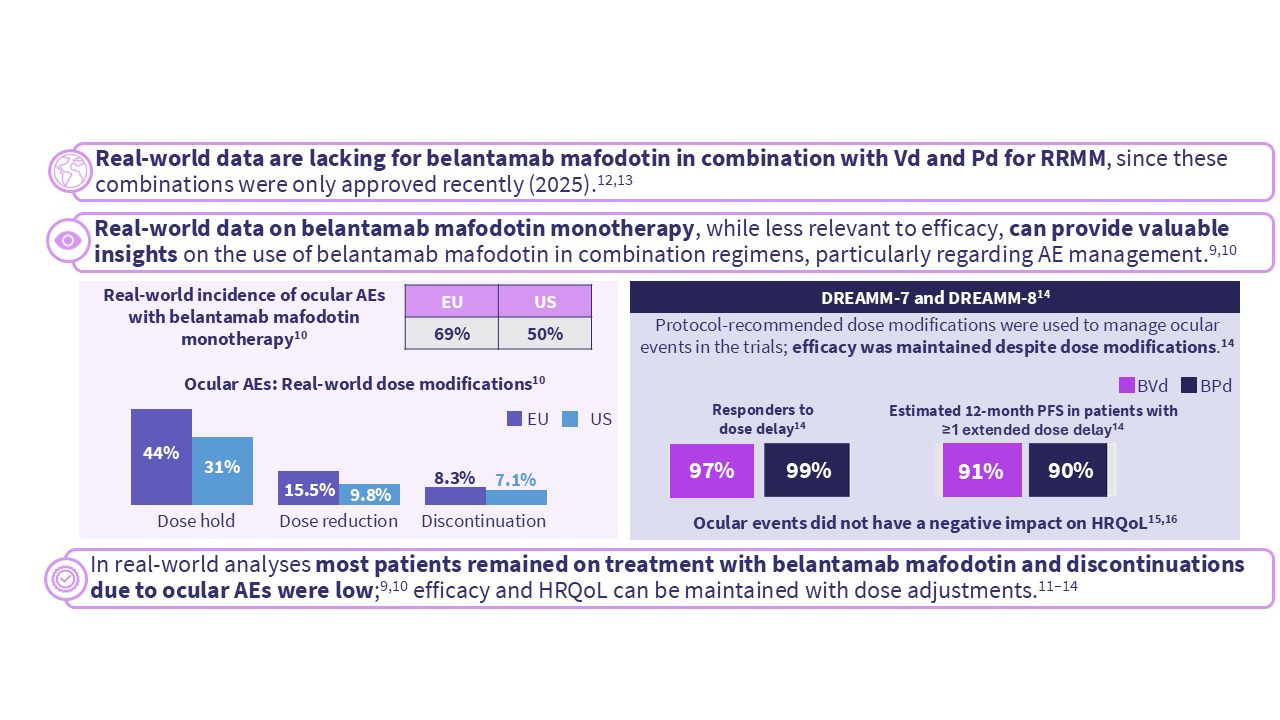
- Experience from real-world use of belantamab mafodotin monotherapy indicates that flexible, patient-specific dosing and treatment delays may help manage ocular adverse events while maintaining efficacy (Figure 2).9–11
Figure 2. Real-world ocular monitoring and safety with belantamab mafodotin for RRMM*
- As BCMA-directed therapies move into earlier lines of treatment, real-world data will have an increasingly important role in informing treatment sequencing, strategies to mitigate adverse events, and optimization of long-term patient outcomes.7
This independent educational activity was supported by GSK. All content was developed independently by SES in collaboration with the faculty. The funder was allowed no influence on the content of this activity.
References
Please indicate your level of agreement with the following statements:
The content was clear and easy to understand
The content addressed the learning objectives
The content was relevant to my practice
I will change my clinical practice as a result of this content
More from this series:
Symposium series | Integrating novel BCMA-directed therapies into clinical practice: Insights from real-world experience

Your opinion matters
Regarding bispecific antibodies for multiple myeloma, which of the following do you consider the biggest hurdle for patients and caregivers?