All content on this site is intended for healthcare professionals only. By acknowledging this message and accessing the information on this website you are confirming that you are a healthcare professional. If you are a patient or carer, please visit the International Myeloma Foundation or HealthTree for Multiple Myeloma.
The Multiple Myeloma Hub website uses a third-party service provided by Google that dynamically translates web content. Translations are machine generated, so may not be an exact or complete translation, and the Multiple Myeloma Hub cannot guarantee the accuracy of translated content. The Multiple Myeloma Hub and its employees will not be liable for any direct, indirect, or consequential damages (even if foreseeable) resulting from use of the Google Translate feature. For further support with Google Translate, visit Google Translate Help.


The Multiple Myeloma Hub is an independent medical education platform, sponsored by AbbVie, Roche, Bristol Myers Squibb, Pfizer, GSK, Johnson & Johnson, Legend Biotech and Caribou Biosciences. Funders are allowed no direct influence on our content. The levels of sponsorship listed are reflective of the amount of funding given. View funders.
Now you can support HCPs in making informed decisions for their patients
Your contribution helps us continuously deliver expertly curated content to HCPs worldwide. You will also have the opportunity to make a content suggestion for consideration and receive updates on the impact contributions are making to our content.
Find out more
Create an account to access:
Bookmark & personalize site content
Receive alerts for new content in your areas of interest
View multiple myeloma content recommended for you
 Paul Richardson
Do you know... What is the most common adverse event observed with CELMoDs in RRMM?
The Multiple Myeloma Hub spoke with Paul Richardson, Dana-Farber Cancer Institute, Boston, US. We asked about cereblon E3 ligase modulators (CELMoDs) for the treatment of relapsed/refractory multiple myeloma (RRMM).
During this interview, Richardson reviews clinical data on the activity of CELMoDs, including mezigdomide and iberdomide, in RRMM. Richardson highlights response rates observed in clinical studies, including activity in heavily pretreated and B-cell maturation antigen (BCMA)-exposed patients, as well as in extramedullary disease. Richardson also discusses safety findings, including hematologic toxicity and infection risk, and outlines emerging data on combination strategies and ongoing phase III trials.
CELMoDs for the treatment of relapsed/refractory MM
CELMoDs for the treatment of relapsed/refractory MM
Key learnings
- In the CC-92480-MM-001 study (NCT03374085), mezigdomide plus dexamethasone demonstrated clinical activity in heavily pretreated patients, including those with prior BCMA exposure and extramedullary disease.1,2
- Clinical activity with mezigdomide plus dexamethasone has also been observed in patients with high-risk cytogenetics and plasmacytomas.1,2
- Mezigdomide has been evaluated in combination regimens with proteasome inhibitors and monoclonal antibodies, with clinical activity observed in early-phase studies.3,4
- In the STOMP study (NCT02343042), mezigdomide combined with selinexor and dexamethasone demonstrated clinical activity in a heavily pretreated population with high rates of prior class exposure and refractory disease.5
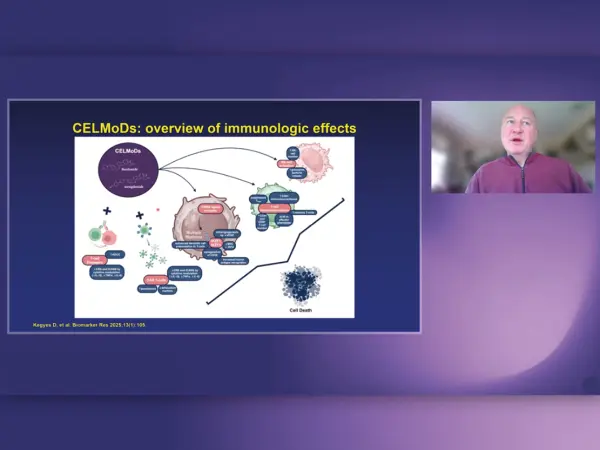
- Pharmacodynamic analyses from mezigdomide-based combination studies have shown increased markers of T-cell activation and proliferation.5
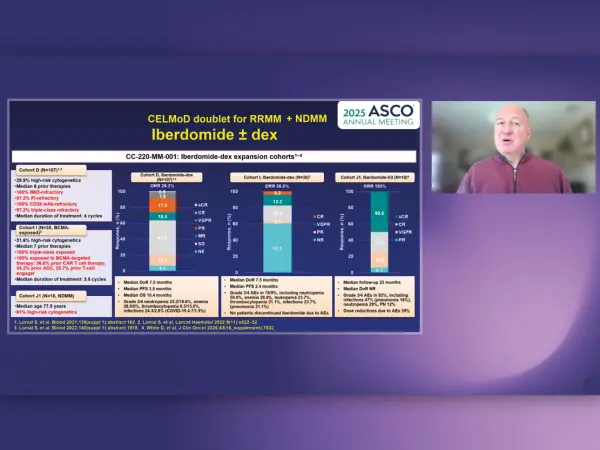
- In the CC-220-MM-001 study (NCT02773030), iberdomide demonstrated clinical activity in RRMM, including in patients with prior BCMA exposure when combined with dexamethasone.6
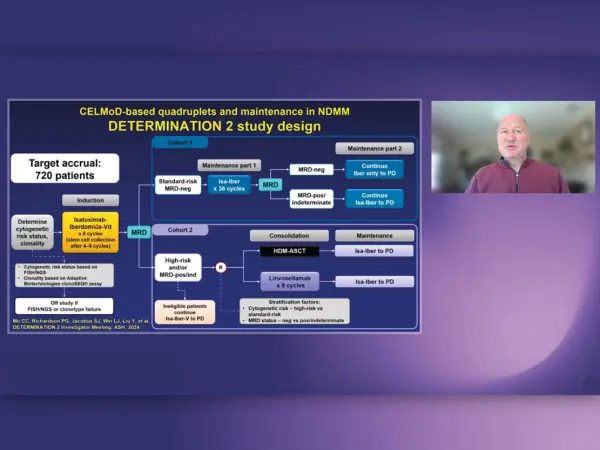
- Iberdomide is also being evaluated in triplet and quadruplet combination regimens with monoclonal antibodies, proteasome inhibitors, and chemotherapy.6–9
- Early real-world data suggest that response rates and safety findings with mezigdomide plus dexamethasone are consistent with those observed in clinical studies.10
- CELMoDs are being evaluated in combination with T-cell-directed therapies, including bispecific antibodies and chimeric antigen receptor (CAR) T-cell approaches, with the aim of enhancing immune responses.11–13
- Hematologic toxicity, particularly neutropenia and thrombocytopenia, is commonly observed with CELMoD-based regimens, and infections require active monitoring in heavily pretreated populations.14
- Phase III studies, including SUCCESSOR-1 (NCT05519085), SUCCESSOR-2 (NCT05552976), and EXCALIBER-RRMM (NCT04975997), are ongoing to further define the role of CELMoDs in RRMM.15–17
This educational resource is independently supported by BMS. All content was developed by SES in collaboration with an expert steering committee. Funders were allowed no influence.
References
Please indicate your level of agreement with the following statements:
The content was clear and easy to understand
The content addressed the learning objectives
The content was relevant to my practice
I will change my clinical practice as a result of this content
More from this series:
Masterclass | CELMoDs for the treatment of multiple myeloma
Your opinion matters
Regarding bispecific antibodies for multiple myeloma, which of the following AE mitigation strategies do you use most routinely in your practice?