All content on this site is intended for healthcare professionals only. By acknowledging this message and accessing the information on this website you are confirming that you are a healthcare professional. If you are a patient or carer, please visit the International Myeloma Foundation or HealthTree for Multiple Myeloma.
The Multiple Myeloma Hub website uses a third-party service provided by Google that dynamically translates web content. Translations are machine generated, so may not be an exact or complete translation, and the Multiple Myeloma Hub cannot guarantee the accuracy of translated content. The Multiple Myeloma Hub and its employees will not be liable for any direct, indirect, or consequential damages (even if foreseeable) resulting from use of the Google Translate feature. For further support with Google Translate, visit Google Translate Help.


The Multiple Myeloma Hub is an independent medical education platform, sponsored by AbbVie, Roche, Bristol Myers Squibb, Pfizer, GSK, Johnson & Johnson, Legend Biotech and Caribou Biosciences. Funders are allowed no direct influence on our content. The levels of sponsorship listed are reflective of the amount of funding given. View funders.
Now you can support HCPs in making informed decisions for their patients
Your contribution helps us continuously deliver expertly curated content to HCPs worldwide. You will also have the opportunity to make a content suggestion for consideration and receive updates on the impact contributions are making to our content.
Find out more
Create an account to access:
Bookmark & personalize site content
Receive alerts for new content in your areas of interest
View multiple myeloma content recommended for you
InMMyCAR: Novel in vivo CAR T-cell gene therapy for RRMM
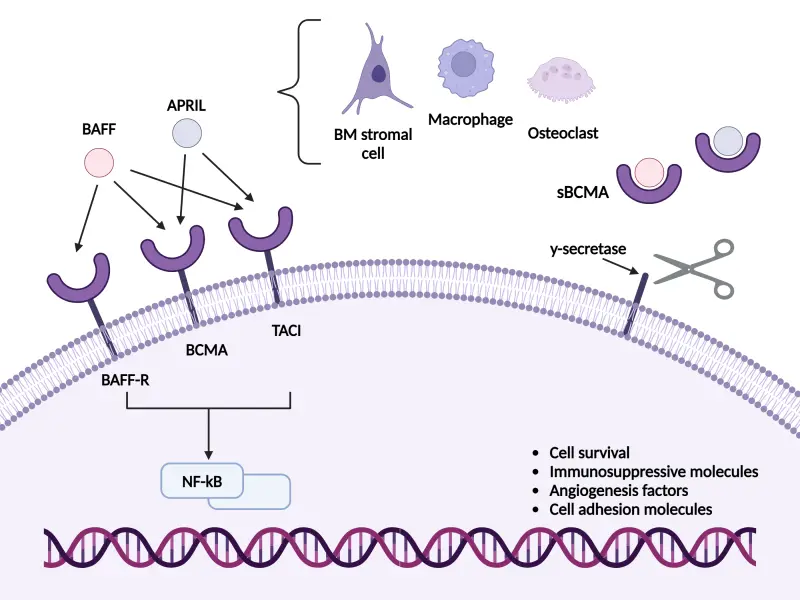
Preliminary results from inMMyCAR (NCT07075185), a first-in-human phase I trial investigating KLN-1010, a novel gene therapy generating anti-B-cell maturation antigen (BCMA) chimeric antigen receptor (CAR) T cells in vivo, in patients with relapsed/refractory multiple myeloma (RRMM), were presented by Phoebe Joy Ho at the 67th American Society of Hematology (ASH) Annual Meeting and Exposition, December 6–9, 2025, Orlando, US. KLN-1010 is a modified, replication-incompetent, self-inactivating lentiviral vector. Unlike traditional CAR T-cell therapy, KLN-1010 employs an intravenously delivered approach that programs a patient's own T cells in vivo to express a CAR, eradicating the need for apheresis, ex vivo manufacturing, and lymphodepleting chemotherapy.
Eligible patients (N ~ 20) had RRMM after ≥3 prior lines of therapy (LoT), including a proteasome inhibitor, an immunomodulator, and an anti-CD38 monoclonal antibody. The primary endpoints were safety, tolerability, and the recommended phase II dose (RP2D). Secondary endpoints were CAR T-cell expansion and persistence, overall response rate (ORR), minimal residual disease (MRD), duration of response (DoR), and progression-free survival (PFS). Results from four patients are reported (n = 3 dose level [DL] 1; n = 1 DL –1).
Key data: Increases in CAR+ T cells by Day 15 were seen in all 4 patients (22%, 35%, 72%, and 85% increases, respectively). All patients displayed phenotypic evidence of persistent memory CAR T-cell formation in the blood and bone marrow after KLN-1010 treatment, with the level of CAR T-cell expansion being commensurate with approved CAR T-cell therapies. All patients achieved MRD negativity by Month 1 (n = 3 at 10⁻⁶ sensitivity; n = 1 at 10⁻⁵ sensitivity), with sustained MRD-negative bone marrow responses at 3 months in the first two patients with longest follow-up. Immune effector cell-associated neurotoxicity syndrome (ICANS)/delayed neurotoxicity and cytokine release syndrome (CRS) were reported in zero and three patients (all Grade 1–2), respectively, with few reports of cytopenia.
Key learning: KLN-1010 demonstrates promising clinical safety and efficacy comparable with approved ex vivo CAR T-cell therapies, supporting the continued evaluation of in vivo CAR T-cell therapies for patients with RRMM.
References
Please indicate your level of agreement with the following statements:
The content was clear and easy to understand
The content addressed the learning objectives
The content was relevant to my practice
I will change my clinical practice as a result of this content
Your opinion matters
Regarding bispecific antibodies for multiple myeloma, which of the following do you consider the biggest hurdle for patients and caregivers?