All content on this site is intended for healthcare professionals only. By acknowledging this message and accessing the information on this website you are confirming that you are a healthcare professional. If you are a patient or carer, please visit the International Myeloma Foundation or HealthTree for Multiple Myeloma.
The Multiple Myeloma Hub website uses a third-party service provided by Google that dynamically translates web content. Translations are machine generated, so may not be an exact or complete translation, and the Multiple Myeloma Hub cannot guarantee the accuracy of translated content. The Multiple Myeloma Hub and its employees will not be liable for any direct, indirect, or consequential damages (even if foreseeable) resulting from use of the Google Translate feature. For further support with Google Translate, visit Google Translate Help.


The Multiple Myeloma Hub is an independent medical education platform, sponsored by AbbVie, Roche, Bristol Myers Squibb, Pfizer, GSK, Johnson & Johnson, Legend Biotech and Caribou Biosciences. Funders are allowed no direct influence on our content. The levels of sponsorship listed are reflective of the amount of funding given. View funders.
Now you can support HCPs in making informed decisions for their patients
Your contribution helps us continuously deliver expertly curated content to HCPs worldwide. You will also have the opportunity to make a content suggestion for consideration and receive updates on the impact contributions are making to our content.
Find out more
Create an account to access:
Bookmark & personalize site content
Receive alerts for new content in your areas of interest
View multiple myeloma content recommended for you
 Meral Beksaç
Do you know... In the DREAMM-8 subgroup analysis of the intent-to-treat cohort with sustained MRD negativity, how much more likely were patients in the BPd arm to achieve ≥CR with MRD negativity vs the PVd arm?
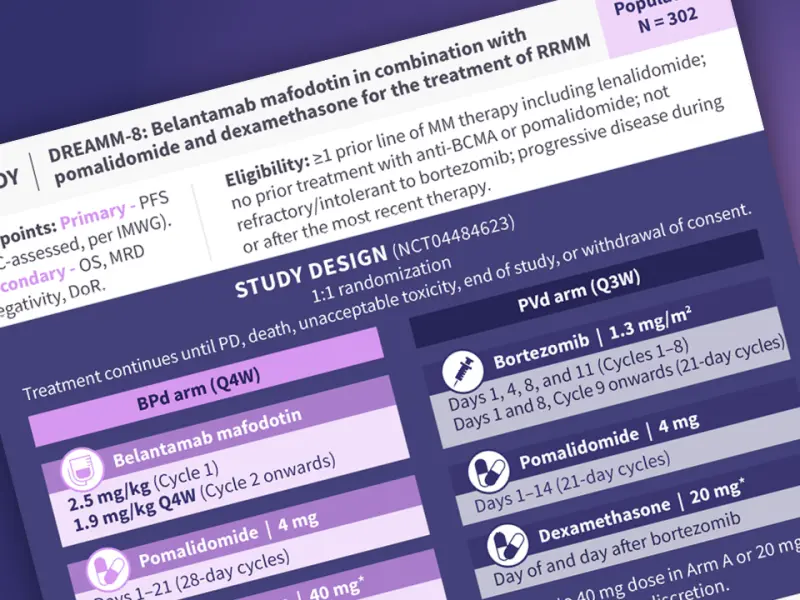
During the European Hematology Association (EHA) 2026 Congress, June 11–14, 2026, Stockholm, SE, the Multiple Myeloma Hub spoke with Meral Beksaç, Istinye University Ankara Liv Hospital, Ankara, TR. We asked about the key findings from two subgroup analyses of the phase III DREAMM-8 trial (NCT04484623) evaluating belantamab mafodotin + pomalidomide + dexamethasone (BPd) vs pomalidomide + bortezomib + dexamethasone (PVd) in patients with relapsed/refractory multiple myeloma (RRMM).
EHA2026 | Key findings from two subgroup analyses of the phase III DREAMM-8 trial in RRMM
EHA2026 | Key findings from two subgroup analyses of the phase III DREAMM-8 trial in RRMM
Key points
The ongoing open-label, randomized, phase III DREAMM-8 trial is evaluating the efficacy and safety of BPd vs PVd in patients with RRMM who have received ≥1 prior line of therapy (LoT).1,2
DREAMM-8 subgroup analysis in patients who received only one prior LoT1
- This analysis included 159 patients from DREAMM-8 who had received a single prior LoT (BPd, n = 82 [median follow-up, 37.9 months]; PVd, n = 77 [median follow-up, 36.4 months]).
- BPd was associated with a 2-year progression-free survival (PFS) benefit compared with PVd, which was maintained following subsequent antimyeloma therapy (PFS, 65% vs 36%; PFS2, 74% vs 58%).
- The overall response rate was 78% in the BPd arm and 88% in the PVd arm; however, more than double the proportion of patients treated with BPd achieved complete response or better (≥CR) vs PVd (51% vs 23%).
- The ≥CR + measurable residual disease (MRD) negativity rates were 39% in the BPd arm vs 7% in the PVd arm.
- Sustained MRD negativity at 2-years was observed in 22% of patients in the BPd arm vs 5% in the PVd arm.
- Safety findings in the second-line setting were generally consistent with the overall DREAMM-8 safety population; Grade 3/4 adverse events were reported in 91% (BPd) and 77% (PVd) of patients.
DREAMM-8 subgroup analysis in patients with sustained MRD negativity2
- After a median follow-up of 35.8 months, patients in the intention-to-treat population who received BPd (n = 155) were more than four times as likely than those who received PVd (n = 147) to achieve ≥CR and MRD negativity (27.7% vs 6.1%), as well as sustained MRD negativity (15.5% vs 2.7%).
- Patients with sustained MRD negativity had durable PFS in both arms; PFS events occurred in 1 of 24 patients in the BPd arm and 0 of 4 patients in the PVd arm.
- In patients without sustained MRD negativity, median PFS was 21.1 months with BPd (95% confidence interval [CI], 15.0–28.4) vs 10.2 months with PVd (95% CI, 8.6–16.0).
- Sustained MRD negativity was also associated with durable PFS2 in both arms; PFS2 events occurred in 2 of 25 patients in the BPd arm and 0 of 4 patients in the PVd arm.
- Among patients without sustained MRD negativity, median PFS2 was 20.2 months with BPd (95% CI, 13.9–24.0) vs 9.3 months with PVd (95% CI, 7.4–11.9).
- Among patients with sustained MRD negativity treated with BPd (n = 24), 75% had received one prior LoT and 21% had high-risk cytogenetics.
- Patients treated with BPd who achieved sustained MRD negativity had features consistent with earlier-stage, lower-risk disease, including one prior LoT, sensitivity to previous therapy, International Staging System Stage I disease, and the absence of extramedullary disease or other high-risk features.
- The safety profile in patients with sustained MRD negativity was similar to previous observations in the overall safety population.
Conclusion1,2
These subgroup analyses support BPd as a treatment option for patients with RRMM, including in earlier lines of therapy and for those with high-risk cytogenetics, and highlight sustained MRD negativity as a marker of durable disease control and long-term clinical benefit across treatment lines.1,2
This educational resource is independently supported by GSK. All content is developed by SES in collaboration with an expert steering committee. Funders are allowed no influence.
References
Please indicate your level of agreement with the following statements:
The content was clear and easy to understand
The content addressed the learning objectives
The content was relevant to my practice
I will change my clinical practice as a result of this content
Your opinion matters
Regarding bispecific antibodies for multiple myeloma, which of the following AE mitigation strategies do you use most routinely in your practice?
.jpeg)