All content on this site is intended for healthcare professionals only. By acknowledging this message and accessing the information on this website you are confirming that you are a healthcare professional. If you are a patient or carer, please visit the International Myeloma Foundation or HealthTree for Multiple Myeloma.
The Multiple Myeloma Hub website uses a third-party service provided by Google that dynamically translates web content. Translations are machine generated, so may not be an exact or complete translation, and the Multiple Myeloma Hub cannot guarantee the accuracy of translated content. The Multiple Myeloma Hub and its employees will not be liable for any direct, indirect, or consequential damages (even if foreseeable) resulting from use of the Google Translate feature. For further support with Google Translate, visit Google Translate Help.


The Multiple Myeloma Hub is an independent medical education platform, sponsored by AbbVie, Roche, Bristol Myers Squibb, Pfizer, GSK, Johnson & Johnson, Legend Biotech and Caribou Biosciences. Funders are allowed no direct influence on our content. The levels of sponsorship listed are reflective of the amount of funding given. View funders.
Now you can support HCPs in making informed decisions for their patients
Your contribution helps us continuously deliver expertly curated content to HCPs worldwide. You will also have the opportunity to make a content suggestion for consideration and receive updates on the impact contributions are making to our content.
Find out more
Create an account to access:
Bookmark & personalize site content
Receive alerts for new content in your areas of interest
View multiple myeloma content recommended for you
 Paul Richardson
Do you know... Conformational changes in cereblon induced by CELMoDs promote degradation of which key substrate transcription factors?
The Multiple Myeloma Hub spoke with Paul Richardson, Dana-Farber Cancer Institute, Boston, US. We asked about the mechanism of action and immunomodulatory activity of cereblon E3 ligase modulators (CELMoDs) in multiple myeloma (MM).
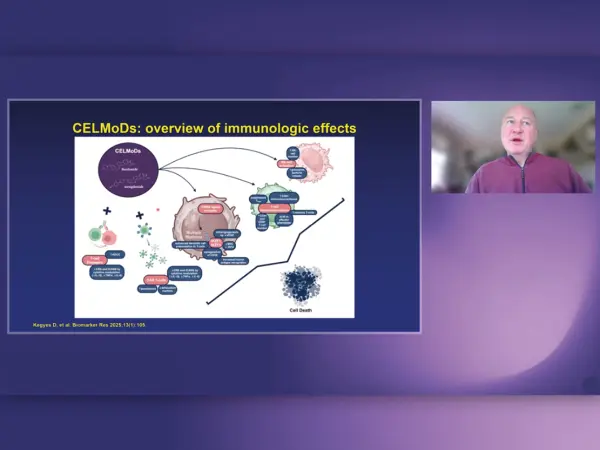
During this interview, Richardson discusses how CELMoDs target the cereblon E3 ubiquitin ligase complex to induce selective protein degradation and immunomodulatory effects. Richardson explains how CELMoDs, such as iberdomide and mezigdomide, differ structurally and functionally from earlier immunomodulatory drugs (IMiDs), resulting in enhanced substrate degradation and immune activation. He notes that anti-MM activity has also been demonstrated in combination with established myeloma therapies. Richardson also discusses translational and preclinical findings on the ability of CELMoDs to overcome resistance and modulate the tumor microenvironment.
CELMoDs: Mechanism of action and immunomodulatory activity in MM
CELMoDs: Mechanism of action and immunomodulatory activity in MM
Key points
- CELMoDs are a distinct class of oral agents that target the cereblon E3 ubiquitin ligase complex.1,2
- Binding of CELMoDs to cereblon induces conformational changes that promote degradation of specific substrate proteins, including Ikaros and Aiolos.1,2
- Greater conformational closure of the cereblon E3 ligase complex with iberdomide and mezigdomide is associated with increased potency compared with earlier immunomodulatory drugs, lenalidomide and pomalidomide.1,2
- Enhanced protein degradation is associated with more profound tumor cell apoptosis, anti-proliferative effects, and immune stimulation.1,2
- In preclinical studies, CELMoDs have demonstrated early signs of reduced off-target effects on CK1α, which may reduce the risk of secondary malignancies.3
- Anti-MM activity has also been demonstrated in combination with established therapies, including CD38 monoclonal antibodies, proteasome inhibitors, and corticosteroids.4–6
- In summary, CELMoDs induce immunomodulatory effects, including activation of natural killer cells and stimulation of T-cell responses.7
- These effects may allow CELMoDs to overcome resistance to prior IMiDs and help reverse the immune-suppressive tumor microenvironment.8
This educational resource is independently supported by BMS. All content was developed by SES in collaboration with an expert steering committee. Funders were allowed no influence.
References
Please indicate your level of agreement with the following statements:
The content was clear and easy to understand
The content addressed the learning objectives
The content was relevant to my practice
I will change my clinical practice as a result of this content
More from this series:
Masterclass | CELMoDs for the treatment of multiple myeloma
Your opinion matters
Regarding bispecific antibodies for multiple myeloma, which of the following do you consider the biggest hurdle for patients and caregivers?