All content on this site is intended for healthcare professionals only. By acknowledging this message and accessing the information on this website you are confirming that you are a healthcare professional. If you are a patient or carer, please visit the International Myeloma Foundation or HealthTree for Multiple Myeloma.
The Multiple Myeloma Hub website uses a third-party service provided by Google that dynamically translates web content. Translations are machine generated, so may not be an exact or complete translation, and the Multiple Myeloma Hub cannot guarantee the accuracy of translated content. The Multiple Myeloma Hub and its employees will not be liable for any direct, indirect, or consequential damages (even if foreseeable) resulting from use of the Google Translate feature. For further support with Google Translate, visit Google Translate Help.


The Multiple Myeloma Hub is an independent medical education platform, sponsored by Abbvie, Roche, Bristol Myers Squibb, Pfizer, GSK, Johnson & Johnson, Legend Biotech and Caribou Biosciences. Funders are allowed no direct influence on our content. The levels of sponsorship listed are reflective of the amount of funding given. View funders.
Now you can support HCPs in making informed decisions for their patients
Your contribution helps us continuously deliver expertly curated content to HCPs worldwide. You will also have the opportunity to make a content suggestion for consideration and receive updates on the impact contributions are making to our content.
Find out more
Create an account to access:
Bookmark & personalize site content
Receive alerts for new content in your areas of interest
View multiple myeloma content recommended for you
Pan-Pacific Multiple Myeloma Working Group consensus: MRD-adapted therapy in MM
Guidelines and consensus recommendations from the Pan-Pacific Multiple Myeloma Working Group (PPMMWG) on the use of measurable residual disease (MRD)-adapted therapy in multiple myeloma (MM) were published in Clinical Hematology International by Chen et al. A modified Delphi process involving a systematic review and anonymous online voting by 17 hematology and oncology experts generated seven consensus statements across four domains: treatment goals in the era of cluster of differentiation 38 (CD38)-based therapy, MRD-guided clinical decision-making, standardization of MRD detection, and integration of novel technologies.
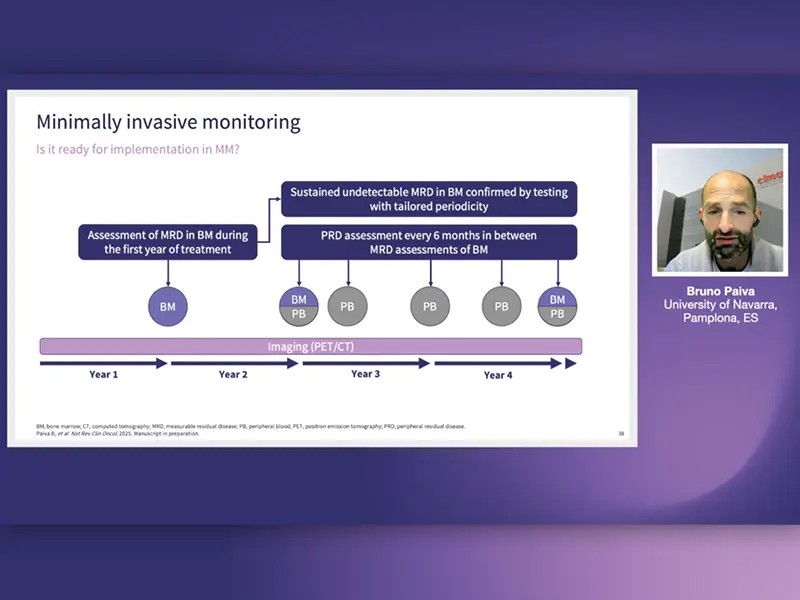
Key data: MRD testing is recommended in patients achieving complete response (CR), particularly following effective CD38-based therapy, and should be incorporated into the treatment evaluation process alongside imaging, bone marrow (BM) assessment, and peripheral blood assays. The frequency and timing of MRD assessment should be tailored to the treatment phase, with testing every 6 months for MRD-positive patients and every 12 months for MRD-negative patients during maintenance. CD38-based therapy is recommended as active maintenance regardless of MRD status, with potential relative benefit for MRD-positive or high-risk patients. Dynamic MRD monitoring is recommended, next-generation flow (NGF)/next-generation sequencing (NGS) are deemed interchangeable for prognostic assessment, and peripheral residual disease (PRD) detection is a key direction for future disease monitoring.
Key learning: These consensus recommendations support dynamic MRD-adapted disease monitoring as a practical framework for risk stratification and individualized treatment decisions in MM.
References
Please indicate your level of agreement with the following statements:
The content was clear and easy to understand
The content addressed the learning objectives
The content was relevant to my practice
I will change my clinical practice as a result of this content