All content on this site is intended for healthcare professionals only. By acknowledging this message and accessing the information on this website you are confirming that you are a healthcare professional. If you are a patient or carer, please visit the International Myeloma Foundation or HealthTree for Multiple Myeloma.
The Multiple Myeloma Hub website uses a third-party service provided by Google that dynamically translates web content. Translations are machine generated, so may not be an exact or complete translation, and the Multiple Myeloma Hub cannot guarantee the accuracy of translated content. The Multiple Myeloma Hub and its employees will not be liable for any direct, indirect, or consequential damages (even if foreseeable) resulting from use of the Google Translate feature. For further support with Google Translate, visit Google Translate Help.


The Multiple Myeloma Hub is an independent medical education platform, sponsored by AbbVie, Roche, Bristol Myers Squibb, Pfizer, GSK, Johnson & Johnson, Legend Biotech and Caribou Biosciences. Funders are allowed no direct influence on our content. The levels of sponsorship listed are reflective of the amount of funding given. View funders.
Now you can support HCPs in making informed decisions for their patients
Your contribution helps us continuously deliver expertly curated content to HCPs worldwide. You will also have the opportunity to make a content suggestion for consideration and receive updates on the impact contributions are making to our content.
Find out more
Create an account to access:
Bookmark & personalize site content
Receive alerts for new content in your areas of interest
View multiple myeloma content recommended for you
How are ocular toxicities associated with belantamab mafodotin managed in MM?
Featured:
 Hermann Einsele
Do you know... Which of the following is NOT consistent with the recommended management strategies for ocular adverse events during belantamab mafodotin treatment?
The Multiple Myeloma Hub was pleased to speak to Hermann Einsele, Julius-Maximilians-Universität Würzburg, DE. We asked, How are ocular toxicities associated with belantamab mafodotin managed in MM?
How are ocular toxicities associated with belantamab mafodotin managed in MM?
In this interview, Einsele discusses the proposed mechanism of belantamab mafodotin-associated ocular toxicity, strategies for monitoring ocular changes, and the role of dose modifications in managing ocular adverse events (AEs) in patients with multiple myeloma (MM).
Key points
- Belantamab mafodotin is a first-in-class humanized antibody–drug conjugate (ADC) comprising an anti-B-cell maturation antigen (BCMA) monoclonal antibody, which binds to BCMA expressed on malignant plasma cells, conjugated to the microtubule inhibitor monomethyl auristatin F (MMAF).1
- Belantamab mafodotin eliminates myeloma cells through a number of mechanisms, including induction of apoptosis and immune-mediated responses, and is an effective treatment option for patients with relapsed/refractory MM.1–3
- Ocular events have been reported with ADCs across a range of therapeutic targets; ocular AEs are common with belantamab mafodotin and may include dry eye, photophobia, blurred vision, and reduced visual acuity.4,5
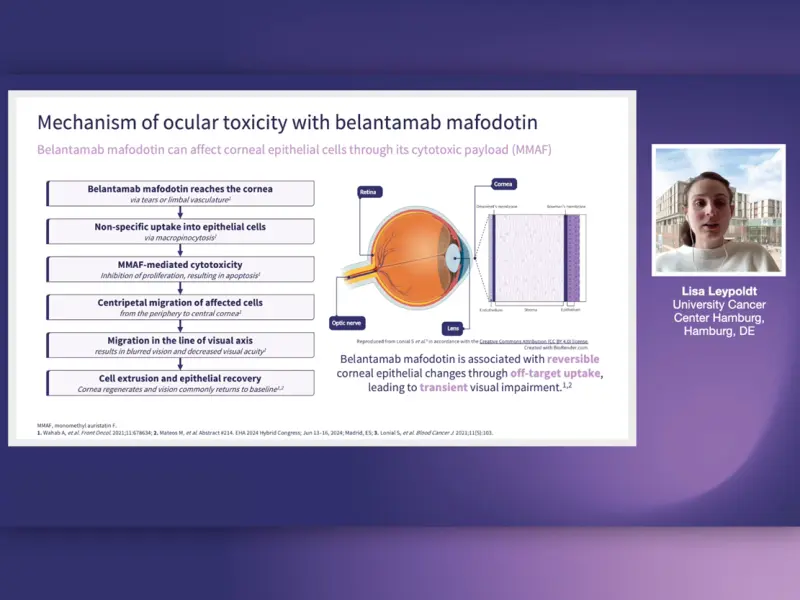
- The exact mechanisms underlying ocular toxicity are not fully understood, although increasing evidence suggests that off-target uptake of the MMAF cytotoxic payload via macropinocytosis by corneal epithelium cells may lead to microcyst-like epithelial changes.5
- Belantamab mafodotin-associated ocular toxicities have been shown to be reversible in most patients (92–98%), with recovery occurring through regeneration of the corneal epithelium.1,6
- Effective monitoring and management of ocular AEs requires multidisciplinary collaboration between hematology, ophthalmology, and primary care teams.1
- Assessment of ocular toxicities should incorporate baseline and ongoing ophthalmologic examinations, including visual acuity testing, and patient-reported symptoms, including the impact of visual changes on daily activities.1‒3,7
- Recommendations for ophthalmologic monitoring differ regionally. The US Prescribing Information specifies examinations at baseline, before every dose, promptly for new or worsening ocular symptoms, and as clinically indicated. In contrast, the EU Summary of Product Characteristics specifies examinations before each of the first four doses and as clinically indicated.2,3
- Early identification and reporting of ocular toxicities can facilitate timely intervention and appropriate management to support treatment continuation.7,8
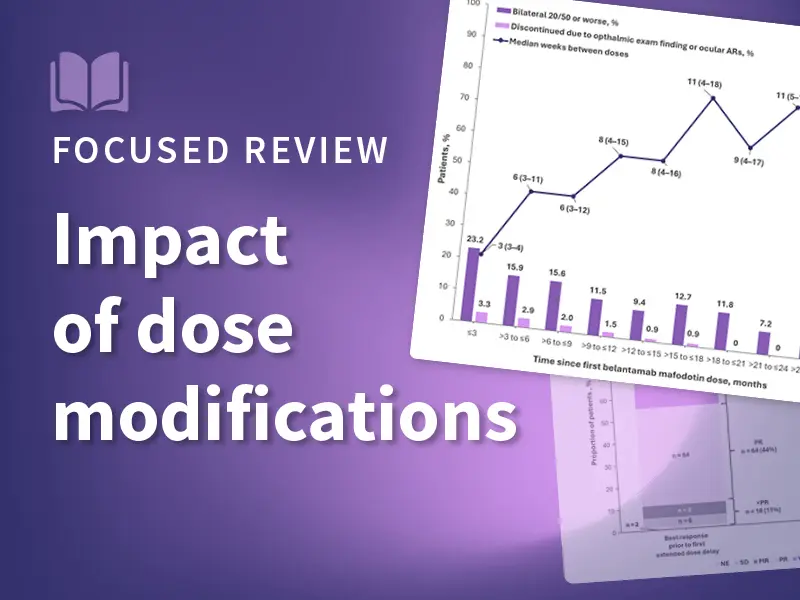
- Belantamab mafodotin-associated ocular toxicities can be managed through dose modifications, including dose delays, treatment interruptions, and extending dosing intervals, with decisions guided by the severity of ophthalmic exam findings.2,3,8
- In the DREAMM-7 (NCT04246047) and DREAMM-8 (NCT04484623) trials, dose delays occurred in 88% and 93% of patients, respectively, while dose reductions occurred in 69% and 58%, respectively.8
- Visual impairments were generally reversible following dose modifications, while treatment efficacy was maintained in both trials.8
- Additional recommendations for the management of ocular AEs include instructing patients not to wear contact lenses, to clean the outer region of the eye, and to wear sunglasses when exposed to sunlight.1,2,3,9,10
- Patient counseling should be incorporated into the treatment plan, including discussion of expected visual changes, their potential impact on quality of life, and the reversibility of ocular AEs following dose modifications.1,7,8
This educational resource is independently supported by GSK. All content is developed by SES in collaboration with an expert steering committee. Funders are allowed no influence.
References
Please indicate your level of agreement with the following statements:
The content was clear and easy to understand
The content addressed the learning objectives
The content was relevant to my practice
I will change my clinical practice as a result of this content
This content is accurate as of the date of publication and is not updated retrospectively. Please refer to the latest available evidence, guidelines, and relevant regulatory information when making clinical decisions.
Your opinion matters
Regarding bispecific antibodies for multiple myeloma, which of the following do you consider the biggest hurdle for patients and caregivers?